


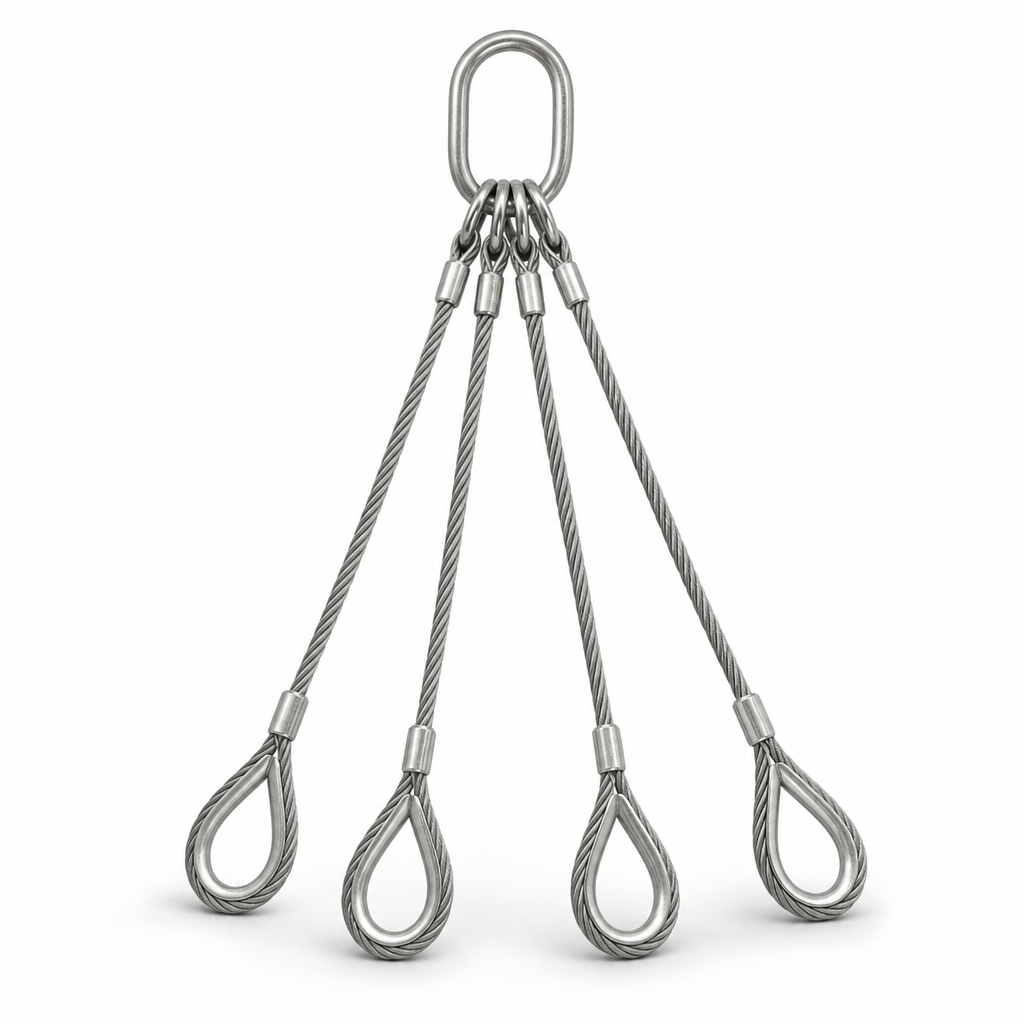
Four leg wire rope slings provide a reliable solution for lifting and handling loads with multiple attachment points. Designed for use with suitable lifting equipment, they help ensure safe and stable load control.
Available in a range of capacities and cable diameters, these multi-leg assemblies are ideal for demanding industrial environments. Each configuration offers a clearly defined safe working load to support safe and compliant lifting operations.
Product Features
- Four leg configuration for stable lifting of complex or uneven loads
- Multiple safe working load options to suit different lifting requirements
- Robust wire rope construction for strength and durability
- Compact cable diameters for easier handling and rigging
- Suitable for use with appropriate lifting points, hooks or shackles
- Clearly defined capacity ratings to support safe working practices
Key Specifications
| Safe Working Load (t) | Cable Diameter (mm) |
|---|---|
| 0.75 | 6 |
| 1.1 | 8 |
| 2 | 10 |
| 2.9 | 11 |
| 4 | 13 |
| 5.8 | 16 |
Applications
- Lifting and positioning loads with four lifting points
- General workshop, warehouse and industrial lifting tasks
- Construction and engineering sites handling fabricated assemblies
- Maintenance operations requiring secure multi-leg lifting arrangements
- Loading and unloading equipment, machinery and structural components
Frequently Asked Questions
How do I choose the correct four leg wire rope sling capacity?
Select a sling with a safe working load that exceeds the weight of the load, taking into account the number of legs in use and the angle between the legs. Always follow relevant lifting guidelines and allow a suitable safety margin.
Can all four legs be used at any angle for lifting?
No, the angle between the legs and the vertical affects the safe working load. As the angle increases, the load on each leg increases. Always refer to appropriate lifting guidance and ensure angles are kept within recommended limits.
What checks should be carried out before using a wire rope sling?
Before each use, visually inspect the sling for broken wires, kinks, crushing, corrosion or other damage. Ensure identification and load rating markings are legible, and confirm the sling capacity is suitable for the intended lift.